EGO-MIND & SELF-PERCEPTION
Although humans are conscious that they are conscious, most of us never think about our thinking; it just happens. We awaken in the morning and think about what we are going to eat, what we are going to wear, where we are going for the day; and then we try to figure out where we left our car keys.
Most of our thinking revolves around the activities of our physical body: feeding it, clothing it, protecting it, moving it and satisfying its many needs and desires. We seldom stop to consider how it is we are conscious or for that matter, what consciousness actually is. Consciousness is something we just take for granted like life itself.
We are born into life and conscious awareness slowly awakens very much like when we awaken from a deep night’s sleep; initially, we wonder where we are; we have no idea where we came from, or where we were prior to our births. We gradually emerge into life from an unconscious state in our infancy to a slowly expanding conscious awareness of ourselves in the world at large.
Over time, our natural minds adapt to the world, and we identify with the body, family, culture and life into which we were born. When we are awake, with a sense of growing permanence, we think of ourselves in terms of “my body” and “my mind” as we busy ourselves with our daily activities. We conveniently forget that we did not create the body we are using nor do we know how it is that we are conscious.
The Natural Mind
It is through the physical body that conscious intelligence meets unintelligent nature. The elemental matter of this universe is nature-matter, which includes our physical bodies; in and of itself nature-matter has no self-awareness. Nature is not conscious, that is, nature is conscious ofits function only. Our physical body is conscious of its function only; it cannot be conscious as itself. Only consciousness can be conscious as consciousness; we are self-conscious beings meaning we are conscious as our self. It is only when conscious light, a.k.a. conscious intelligence, is integrated into a physical body that the body appears to be alive and conscious.
“The body-mind identifies with the ego-personality so thinking is thoroughly
and completely identified with the physical body and the natural world.”
The conscious intelligence we experience as “our consciousness” is so dispersed in the nerves and blood of our body that we are unable to formulate an awareness which allows for us to distinguish who we are separately from the body and senses. As we become more oriented to our physical form, we become conscious of the impressions of the senses as well as the sensations of the body, and gradually, we become more and more conscious of the natural world in which we live.
After a time, we are unwilling to disengage from the natural world long enough to realize that we are a conscious being separate from the body. There is the constant bombardment of physical sensations in the body which holds captive a person’s attention to the things of the natural world, and it is this experience of sensation that dominates our thinking.
It is only because of conscious intelligence being integrated into the nature body that we are able to formulate an understanding of the natural world. After years of experiencing physical sensation, thinking becomes completely identified with the physical body and the things in the world the body and ego desire. Conscious thinking becomes the “body-mind” which is the “psycho-corporeal consciousness” comprised of the body’s instincts, cravings, impulses, feelings, desires, and physical sensations. Thus, the body-mind facilitates and identifies with the ego-personality so thinking is thoroughly and completely identified with the physical body and the natural world.
The Awakened & Unawakened Self
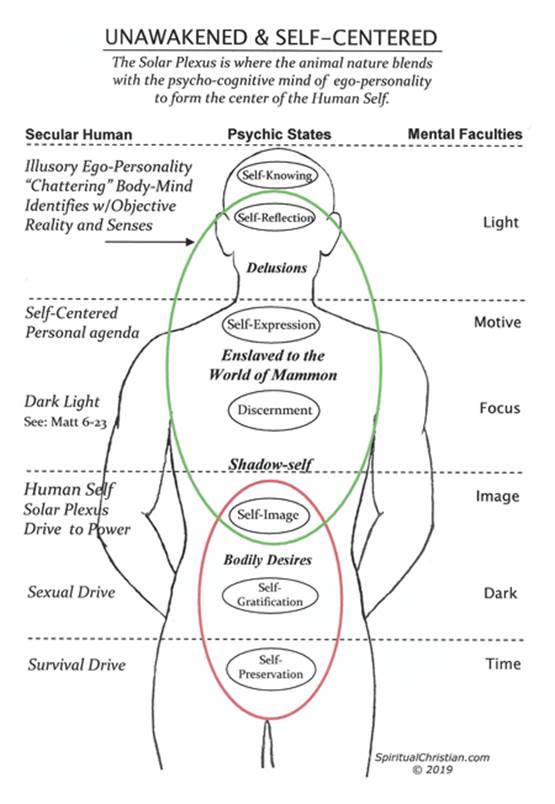
The centers of awareness influencing what people manifest in their thinking regarding the world are shown in the green and red circles above. The personal characteristics of the Human Self are expressed through the Self-Image of the ego-personality which is deeply ingrained in the 3 primal drives from the lower centers of the body. The forces at play in the unawakened human include the rationalizing ego-mind which is dedicated to thinking and judging the world and its affairs; and the ego-personality with all its self-centered cravings, instinctual drives, bodily impulses, and sexual desires of the physical body. The synchronistically integrated blend of the rational cognitive mind, the psycho-emotional energies, the shadow-self, and the primal drives of the physical body are centered in the ego-personality; these comprise the body-mind.
Generally speaking, these forces in the unawakened human tend to manifest in the ego-personality of an individual in varying degrees of self-centeredness. Self-centeredness originates from the 3 lower centers of: self-preservation, self-gratification, and self-image. All human thinking is determined by which forces come into play in their lives; being receptive to the various energies of the body-mind determines what quality of thoughts are entertained and how and where thinking will be directed. The heart center discerns, regulates, and balances opposing and contrary thoughts. With the exceptions of focusing on work, study, or some creative endeavor, the conscious thinking is caught up in the “chattering-mind” of the ego 24/7 and will be influenced by or identifying with the lower centers of self-perception shown above.
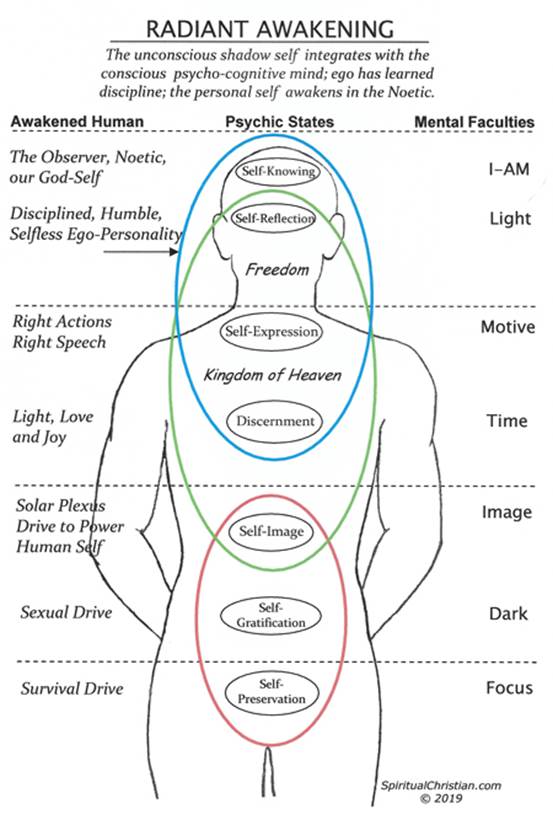
However, through discipline, meditation and focused breathing, the awakened human minimizes the influence of the lower centers upon the thinking process; this begins to transform and subdue the impulses and desires of the lower centers. Meditation enables the individual to focus attention in the present moment, and thus gain control of the chattering-mind, keeping it quiet. In this transformative process one is freed from the lower desires and impulses which disturb the conscious self (Stage 1) and the shadow is revealed and transformed in the light (Stage 2). The ego-persona and body-mind becomes more attuned to the spiritual nature as the heart center (Stage 3) feels peace, serenity and new life. The reasoning mind and intuition becomes more conscious, present and focused on spiritual perceptions, values, and quality of character of the awakened human. Now, the heart functions as the center for the sacred while rejecting the opposing forces of the profane; the Divine I-AM consciousness awakens in Stage 4.
Self-Perception
In order to examine the different levels of perception humans experience in the centers of awareness in the body, it is necessary to realize and understand the miraculous qualities of the human body because the physical body is something unique to each person. At one end of the spectrum, the unawakened individual thinks the body is a burden filled with cravings, fears, and dark impulses which need to be satisfied. Life for this person primarily revolves around fulfilling the body’s desires for: food, sex, rest, habits, and entertainment.
At the other end of the spectrum, we are told that we are the temple of God and the Spirit of God lives within us (1Corinthians 3:16). The physical/spiritual body has miraculous capabilities and potentials we are hardly able to imagine. We know that 2000 years ago Jesus Christ performed numerous miracles while in the primordial Adamic human body and lived a selfless life of unconditional love. He came to show us a way to live and a way to be; he manifested for us the full potential of the divine-human. He sanctified all human flesh meaning that what He did in the physical body opened a door to the divine for all human beings to experience; at least, those who have the discipline and true desire to embrace the Christ light and the Way of Life.
The quality and character of a person is determined by the level on which his or her thinking is focused. The problem is most people have absolutely no control of their thinking; what they think of as their thinking is actually the “chattering-mind” of the ego yakking about physical sensations and cravings in the body as well as the objects of the material world; it must yak 24/7 to keep “the ego illusion” viable in our minds.
Here is an analogous story to explain how the chattering-mind alters our worldly perceptions: Imagine gazing into a natural pool of water, except every second, a pebble drops into the pond sending ripples across the water. This rippling effect is how people experience the world because the chattering-mind is the pebble. Now, imagine the pebbles stopping, and the pool becomes still. For the first time, you notice another world reflected on the surface of the water and then you notice another world in the bottom of the pond. This pool of water represents our world; there are other realities right in front of us if we could stop the chattering-mind and learn how to perceive these higher realities.
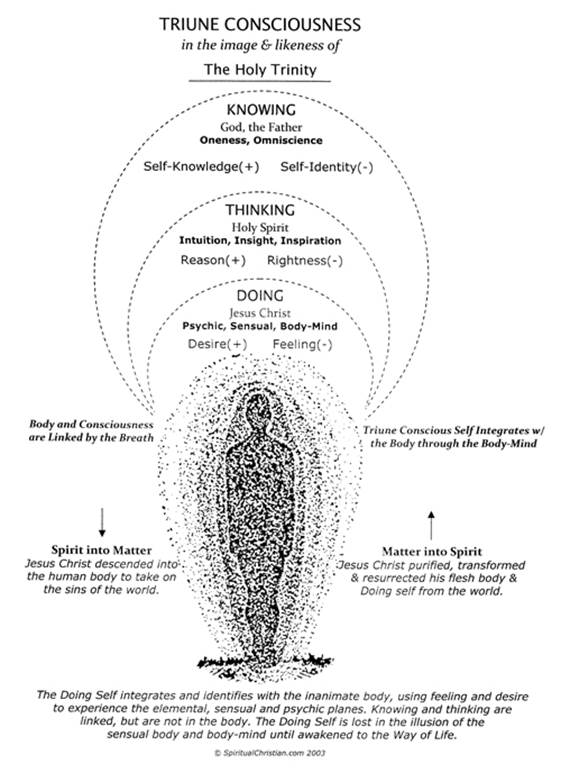
If the chattering of the ego rules our lives, we will be self-absorbed in the body and in the 3 lower regions of perception trying to survive, trying to gratify the desires of the body, and constantly trying to validate and bolster our self-image because the ego-mind it is not real. In the Gnostic teachings, the ego-persona is referred to as the “counterfeit spirit.” The ego-persona borrows its sense of identity from the triune divine-human Self (bottom diagram). With this false identity and the experiences and sensations garnered from being in a body, the ego-personality feels that it is real; but it is an illusion. The ego-personality exists solely as an “illusory notion” of itself.
Consciousness has many potentials and internal realities, but before we can perceive and understand them, we must stop the pebbles and we must stop believing that the rippling water of the pond is the only reality. To understand reality beyond the pond, we must understand the 7 levels of self-perception and how they are synthesized in the body-mind as the ego-personality. Being in a body, and perceiving and thinking through the body-mind, causes an unawakened person to constantly be anxious about self-validation.
“The difference in the quality of life of an individual is directly proportional
to how the attributes of higher intelligence operate in a person’s life.”
SpiritualChristian.com
Duality, Thinking, and Self Perception
We are all trapped in the realm of duality and don’t even know it. It is like the story of the fish and the water. Imagine we go up to a fish swimming in the ocean and say to him, “How is the water, Mr. Fish?” And he says, “What water?” We lift him up out of the water into the air and drop him back in and he says, “Oh, the water is fine.” We are stuck in third dimensional reality like the fish is stuck in water until we have an experience that shows us otherwise.
We experience life in a third dimensional reality of space-time which has up-down, near-far, and slow-fast. We also occupy an elemental body of nature and decipher our experiences with conscious thinking that explains life in terms of good-bad, right-wrong, profit-loss, like-dislike, and favorable-unfavorable. It is primarily our desire for the appealing things in life that makes us feel good or bad. We are happy when we get what we desire and feel disappointed when we don’t get our way.
There is also a tendency for us to explain and orient the experiences of life in terms of feeling and desire as they relate to our body. We frequently monitor our well-being in terms of how we are feeling or we gauge our success in life by how well we are getting what we desire.
The body-mind experiences the physical body through instinct and a variety of tactile sensations, but also through the 4 vital systems, the senses, and the blood. Feeling/desire in the body-mind experiences sensation and stimulation of the body through the 7 centers of perception in the nervous system. Sensation and stimulation can arouse the body/body-mind on the animalistic level instinctually, or it can stir feeling/desire on a psychic level with emotions and cravings, or it can awaken love, compassion and sublime sentiments in the higher psychic all depending on how and where we focus our attention.
However, when we add intellect and sentiment to this base equation, we begin to delve into the infinite variations of human beings. Some of us are smart and others are not; some of us are compassionate and others are not; some of us are perceptive and others are not; some of us are analytical and others are not; some of us are optimistic and others are pessimistic; some of us are peaceful and others are violent; some of us are caring and others are loveless, some of us are spiritual-minded and others are material-minded, and the list goes on.
The difference in the quality of life of an individual human being is directly proportional to how the attributes of higher intelligence operate in a person’s life. These attributes of higher consciousness are reason, conscience, inspiration, empathy, intuition, selflessness, compassion, integrity, persistence, and courage.
Some people incorporate these characteristics into their lives and strive to become a “quality person.” Other people ignore these higher characteristics because they are focused on satisfying the desires of the body/body-mind/ego (personal self) which is the realm of duality: like-dislike, profit-loss, happy-sad, satisfied-dissatisfied. These people serve their egos and leave the truly important thing undone. Below is the Tree of Life superimposed over the body and its spiritual centers; the mundane life experiences are in red.
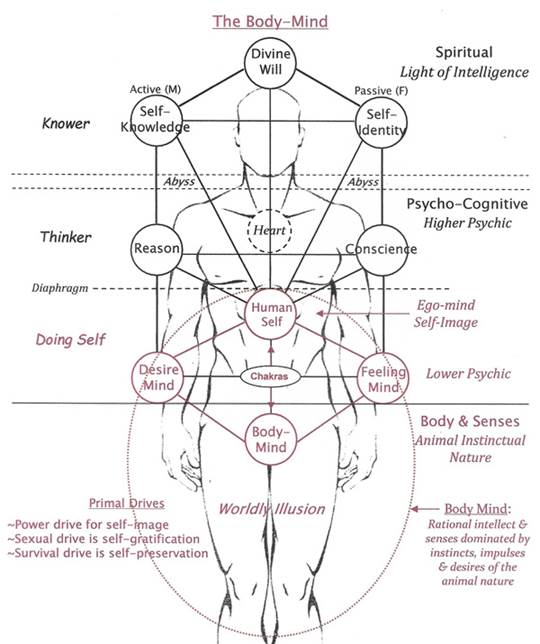
The quality of thinking has a great deal to do with the way we explain to ourselves the experiences we go through in life. Are these experiences thought of in terms of higher values or are they thought of in terms of satisfying the personal desires? The synthesis of the body/body-mind, feeling-desire, and the ego-personality has oriented each of us to a unique perception of our individual life experiences. The “chattering-mind” of the ego-personality has a running commentary going on about what is happening with our world, our body, and our lives; it chatters about who the ego likes and who it doesn’t like, what it wants and what doesn’t want, how the body looks, and how we should act and react to be socially acceptable.
With the exception of when we are sleep, this chattering of the ego takes place 24/7; this is what we think of as thinking. Although it is not real thinking, it influences and configures our worldview, our feelings, our desires, and how we deal with life and the people around us. The chattering of the ego is the means by which the ego-personality keeps a person’s attention trapped in the body/body-mind and in this third dimensional world of duality. In order for us to truly be free, the ego-personality must “die” to who it thinks it is so we can become who we truly are.
This earthly life is temporary, the body is temporary, and the opportunities we have are temporary; but there is an important purpose to this journey – life experience for the soul. Life experience is the only thing we take with us when we leave this world. Depending on the quality of the person, the life experiences either serve the body and personal self or they serve the soul and spiritual Self.
If the life experiences revolve around the personal self, they are serving the desires of the nature body. If the life experiences revolve around the spiritual Self, they are serving the conscious light which nourishes and educates the soul. Cause and effect is the law of life; we reap (in the future) what we sow (in the present). So which would be better to serve, spirit and soul or form and dust?
SpiritualChristian.com
*
* *