MEDITATION
Why Meditate?
Peoples’ lives change each day, consciously and unconsciously, as they attempt to maintain balance (homeostasis, see: Ego and Religion) in the changing circumstances of their world. They constantly struggle to make their ideal life a reality and they often suffer when their efforts are thwarted and their expectations fall short. The uncertainties and difficulties encountered in life are often experienced as states of frustration, despair, or hopelessness. These terms are used to express the feelings which arise when the consciousness is not properly aligned with the individual’s desires, aspirations, ideals, values, intentions, or in a word, his or her own unique destiny.
These conflicted states as well as the darkness, negativity, and violence of the world often influence the physiology, psychology, and general well-being of the individual. In the extreme, these states can be experienced in the body as feelings of depression, anxiety, dark moods, stress, tension, loneliness, and various kinds of negativity. This paper refers to these states which take up residence in the memory of the cellular structure of our bodies as “residual corruption.”
Generally, the body’s memory is thought of in terms of instinct, but repeated patterns of stress, anxiety, depression, negativity, or disharmony as well as environmental pollutants can also be established in this collective organic memory which is referred to in these writings as the body-mind (See: Thinking). Residual corruption varies from person to person which means the patterns of one person’s bodily responses are different in degree from those of another. For instance, two people will react differently if they are surprised by a snake or they will have a different bodily response to bad news or to life in general. People of faith tend to have a stronger or more peaceful constitution than those who live a secular life.
The experience a person has with regard to these instinctual patterns, residual corruption, emotional turbulence, and organic conditions in the body/body-mind is the starting point for this meditation process. The first stage of this meditation clears and purifies the body and body-mind of residual corruption, unwanted anxiety and stress, and the primal fears which come from being in a physical body, but before negotiating the first stage, a breathing technique must be learned and established first.
Resurrection Meditation
There are many benefits that can be derived from the practice of meditation like good health, relaxation, peace of mind, and emotional stability. Although these benefits will be experienced as a by-product, they are not the goal of this particular Christian meditation. This meditation can best be explained using two verses from the GH12. The first is verse 94.3, “There is a resurrection from the body and there is a resurrection in the body. There is a raising out of the life of the flesh and there is a falling into the life of the flesh. In God they live and move and have their being.” The meditation and instructions discussed in this paper refer to the “Resurrection in the Body” meditation.
The goal of the “Resurrection in the Body” meditation is described in verse 69.5, “And one of the disciples asked him, ‘How shall a man enter into the Kingdom?’” And he answered and said, “If ye make not the below as the above and the left as the right and the behind as the before, entering into the Centre and passing into the Spirit, ye shall not enter into the Kingdom of God.” This meditation guides practioners in a process which releases illusory attachments to the world and purifies and stabilizes the emotions as a preparatory step for “moving into the center and passing into the spiritual.”
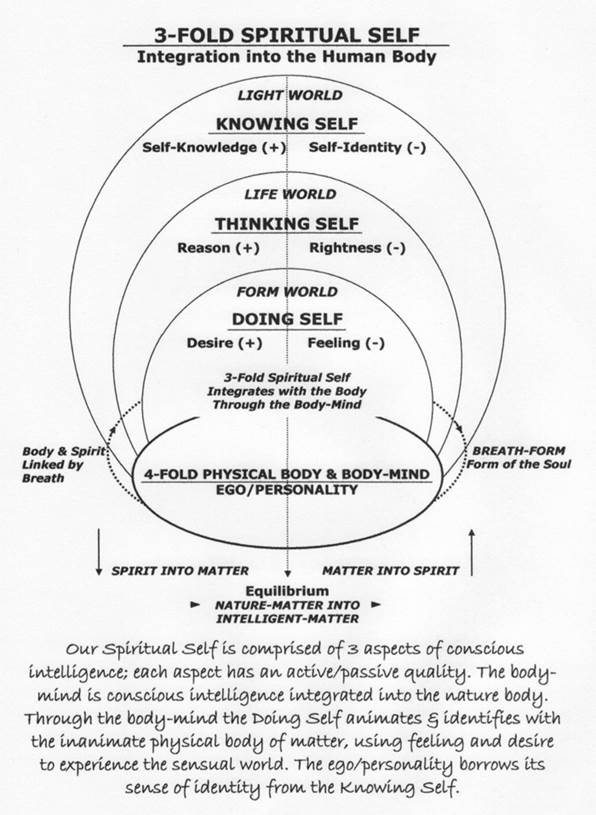
In order to “pass into the spirit,” a person must utilize an internal focused breathing technique to negotiate through the four vital systems of the body: the physical body/corporeal soul, the emotional/psychic soul, the mental/cognitive soul, and the noetic (spiritual)/radiant soul (see diagram below). In this 4-stage meditation system, as each stage is completed, the next stage reveals itself. The instructions in this paper deal with the focused breathing exercise that is the key for negotiating these internal realities.
In verse 66.13, Christ explains the perfect balance of the “two in one” mystery which can be achieved in this meditation, “And one said unto him, ‘Master, when shall the kingdom come?’” And he answered and said, “When that which is without shall be as that which is within and that which is within shall be as that which is without and the male with the female neither male nor female, but the two in one. They who have ears to hear, let them hear.” When seriously embracing the internal spiritual reality of the physical body, we encounter the dual polarities that are actually one reality: male/female, feeling/desire, rightness (conscience)/reason, and self-knowledge/self-identity. “Entering into the centre” means we must bring into balance these whirling opposites of life and hold them in perfect equilibrium within ourselves.
People who want to meditate to learn how to relax do not need the instructions in this paper. But people who want to meditate so they can “enter the Centre and pass into the Spirit” need these instructions as well as a deep commitment to strive for personal self-mastery for they will need to allow the process to alter their present worldview. Everyone’s worldview is firmly anchored in the duality of our 3rd dimensional world where we perceive experience in terms of like-dislike, good-bad, want-don’t want, favorable-unfavorable, profit-loss (See: Worldly Illusions). This meditation presents us with a process for recognizing and letting go of our attachments to the world as we move from duality consciousness into oneness consciousness; then we can be in the world, but not of the world.

The Personal Worldview
The thoughts, feelings, and desires which run through our minds from daily experience condition the consciousness and influence our self-concept, altering the configuration of internal feelings we have regarding life. Any conflict, turmoil, or contradiction we may experience in life between our internal hopes and external realities are found in the patterns of our thinking. Our thought patterns are continuously and habitually being etched onto the body-mind each and everyday through our reactions to life. This is how the personal worldview is continuously configured. The worldview is about the collective life experience, the self-concept, and the personal feelings and desires of the individual.
Thus, from our worldview, we form our own unique perspective about life, which influences the nature of our experiences. Relative to the relationship we have with our bodies, our experiences, our attachments to the material world, our self-concept, our individual desires, and our relationships with others, we formulate our unique worldview. Our worldview likely contains beliefs about the political and social world-at-large, which will include our real and imagined fears, prejudices, misperceptions, misconceptions, personal desires, limitations, and dreams.
The significance of the worldview is important because whenever we experience life, we will always have a reaction or response that is based on our worldview. What this means is that we will see life as we are, not as it is. The optimism or pessimism of our worldview is synonymous with the way we perceive and experience the world and others. The unique experiences we draw to ourselves from the world will affect our beliefs, and these beliefs will, in turn, alter our worldview, which alters our perspective, which alters the way we experience life, which determines the kind of experiences we will draw to ourselves and establishes the way we will interpret these experiences. Everyone is caught in this perpetual loop-of-life experience.
In this realm of duality, on a daily basis, we encounter people, situations, and things in the world to which we are either attracted or from which we are repelled. This magnetic impulse determines our response to these external objects, events, and people of the world and this response is registered and felt in the body/body-mind. From these sensual/magnetic experiences, we establish impressions on the various circumstances, things, and people in the world, all of which further create our worldview.
These impressions will have us either desiring to re-experience the pleasure we have previously experienced or it will make us want to avoid encountering the things we don’t like. These responses will be stored in the body’s memory where they will arise whenever similar situations occur. This cycle of pleasure and pain will be repeated continuously throughout the day, everyday. This cycle is how we compare and analyze our experiences and determine whether our life is successful or not, that is, whether we are moving toward or away from our ideals.
For many people, worldly experience has become a painful struggle because their beliefs about how they would like life to be are in sharp contrast to the reality they experience. They do not know how to get free from this endless cycle of pleasure/pain. The degree to which the pleasure/pain cycle affects us is determined by how much we have invested in a specific outcome and whether an experience manifests the way we want it to. This loop-of-life experience is the ongoing perspective that anchors us to 3rd dimensional reality and it is where our entire life is spent and where it will come to an end unless some action is taken to change this course. Whether our strategy in living is to have an ideal life or to just make improvements in the quality of our everyday experience, the key is learning how to control and properly manage the internal thoughts and reactions we have to life.
Meditation is the means through which we can escape from the back and forth cycle of duality as well as from the misunderstandings and misconceptions that come from worldly illusions. With a concerted effort, we can change our natural minds (Adam) to our spiritual minds (Christ). Christ tells us, “As in Adam all die, so in Christ shall all be made alive.” But the key is that we must “die” to the worldly illusions and to our self-concept so we can awaken to who we really are. In others words, die to who we think we are so we can experience who we really are; die to the mundane and awaken to the spiritual.
This enables us to gain the personal power, knowledge, and clear perception we need to reach internal equilibrium. Spiritual balance comes from standing at a point of equilibrium between pleasure/pain and accepting both with equanimity. Spiritual balance is having enough internal power, knowledge, and spiritual realization that the elemental forces of nature or the illusions of the world are unable to tip the balance of this internal peace. The fastest and most effective method for experiencing internal equilibrium begins with the focused breathing meditation.
Focused breathing calms the mind, controls the breath, and subdues the body which minimizes the pull that elemental nature has upon it. This inner serenity creates the condition in which negative patterns can be easily neutralized, dissolved, and eliminated from the body-mind and this, in turn, compels the nature-matter of the body to change accordingly. This process etherizes and spiritualizes the matter of the body turning nature-matter into intelligent-light or vital life into vital light. This is what Christ refers to as the regeneration of the soul.
Focused Breathing Exercise - Instruction
The beginning of the transformation process starts with the subduing, smoothing, and refining of the physical breathing, which relaxes the cellular structure of the body to the point of deep, slow, and extremely smooth breaths. Control of the physical breathing is the beginning of purging the body of its fears, anxieties, misconceptions, and impurities. As the breath is refined and purified, the body/body-mind begins to experience a natural harmony, peace, and rhythm not felt before.
The ego-personality and the forces of nature are a formidable adversary in this process and should not be taken lightly. It is the ego-personality that must be completely subdued and disciplined; it will fight any attempts at altering its power base. The ego holds tightly to getting what it wants and to its attachments in the worldly illusion. The ego state is a very complex and challenging barrier between present awareness and the inner peace and realization of light that can be achieved.
In the beginning exercise, focused breathing begins to withdraw our personal power away from the pull of nature and the influence of the ego/body-mind and return it to us as increased awareness, concentration, and vitality. As power is withdrawn from the physical, sensual realm and turned within, it awakens the higher levels of consciousness and revitalizes the physical body.
This transformation process will progressively awaken us to our spiritual nature. Practicing this exercise daily begins to alter the consciousness, making it focused, resilient, patient, positive, disciplined, strong, and persistent. As our consciousness changes for the better, conditions like anxiety, stress, emotion, craving, and related pain are literally dissolved from the body. This paper advocates monitoring spiritual progress in terms of character development also. In other words, as a result of practice and increased realization, we will become less emotionally volatile and more balanced, patient, fearless, serene, confident, courageous, and accepting of the future.
Guidelines for the Breathing Exercise
If possible, it is important to have an established meditation area, a comfortable sitting position, and a set time period for meditation practice. Relax the body and sit up straight. Use any sitting position that is comfortable whether it is sitting cross leg or sitting on the front edge of a chair. With the clarity and power of this system of thinking, the sitting position doesn’t matter as long as you can focus and the body is not creating distractions. Place the tip of the tongue to the back roof of the mouth where the soft palate begins. Placing the tongue in this position closes a circuit in the body’s electrical system so nervous energy can flow unimpeded (circular i.e., up the spine, over top of the head, down the front, to base of spine) throughout the body. The tongue in this position may feel awkward at first, but that will quickly pass. The thumb and first two fingers of each hand may touch or the palms may rest together to close another circuit.
Follow the breathing for a moment or two and continue to relax the body. Notice that there is a slight pause at the beginning of each inhale and exhale. After a few breaths, eliminate this pause so the breathing is connected, in other words, there are no pauses. The use of connected breathing seals the body off from intrusion by the elemental energies of nature which enter the involuntary nervous system during the pauses in breathing. This nature energy plays along the involuntary nervous system stimulating the senses, creating sensation, and inducing mind-chatter. Connected breathing prevents stimulation to the body and senses allowing for improved concentration. Practice connected breathing until it feels comfortable. Try to keep the mind-chatter quiet; concentration of the mind is the key to success.
When the breathing is relaxed, guide the breath to the center of the body. This is the area behind the navel, that is, between the navel and the spine in the center of the body. This is the central cavity of the body which Taoists, Qigong and Tai Chi practioners, and alchemists refer to as the middle cauldron. It is just below the location of the solar plexus. The exercise at the navel works with the elemental and vital life energies of the body, whereas the solar plexus center works with the psychic (emotional) level of energy. The work on the solar plexus and psychic level are in the second stage of this meditation system.
The central cavity, especially behind the navel, is where embryonic breathing takes place when we are in the womb. The embryo pulls nourishment from the mother through the umbilical cord, which feeds the body through the navel. After birth, infants continue to breathe from this area because it feels natural. It is only when the consciousness awakens and begins to integrate with the body that this natural breathing cycle is interrupted. The focused breathing exercise, when done correctly, will reconnect a person with this natural breathing cycle bringing a deep sense of peace and relaxation.
Locate the embryonic area within the central cavity by finding the spot that feels most comfortable (or warm, or tingly, or just feels right). Stay focused in this area and concentrate on the connected breathing. Relax the body so the breaths become long, slender, and smooth. The breath, body, and mind are interconnected; refinement of the physical breath calms the body and stills the mind. Improved skill in this exercise will be noted as the breath becomes refined, that is, calm, slow, and smooth.
For many people not experienced in meditation, it is challenging at first to get the mind to be quiet. For most of our waking life, our conscious awareness has been totally dominated by the ego and the ego is not going to relinquish its hold without a fight. Nevertheless, one of the first goals of meditation is to neutralize the influence the ego has on our conscious attention. Forcing the attention to focus on breathing is one of the most effective methods to shut down the ego. Another challenge for some people who are just beginning meditation is encountering the “shadow self.” The shadow self is a term used in psychology which refers to a repository of negative, fearful, and dark energy that we have created in our life and then “stuffed down” into the unconscious (there is no subconscious mind, only varying degrees of unconsciousness). The shadow self can be comprised of hurt feelings, regrets, guilt, sins, and any “dark event” in our lives which we have not faced and come to terms with. Essentially, the shadow self is part of the residual corruption which resides in the physical body. Residual corruption is a “dark light” which the focused breathing exercise will transform into spiritual light. In the GH12 (26.13) Jesus said, “The lamps of the body are the eyes; if therefore thy sight be clear, thy whole body shall be full of light. But if thine eyes be dim or lacking, thy whole body shall be full of darkness. If therefore the light that is in thee be darkness, how great is that darkness!”
In the focused breathing exercise, if there is significant mind-chatter that disturbs the concentration, focus on the tip of the nose while breathing until control is regained. Another method is to follow the breath in and out of the nostrils and if necessary, count the breaths from 1-10 and back from 10-1. The goal is to focus on the breathing without interference from the mind-chatter, the shadow self, the body-mind, or the emotions. In the beginning, this may mean pulling the attention away from these disturbances repeatedly until they lose their power to disturb the breathing. Simply acknowledge what has distracted the focus and gently and patiently let it go while bringing your attention back to the exercise.
The goal of this exercise is to subdue and to regulate the mind and to harness the vital energy through the control and refinement of the breathing. The state of focus will be felt within the body as the balance of opposing mind tension. In reality, focus is the ability to hold the attention steady on a given subject. The goal will be realized when the state of focus can be maintained with effortless effort.
There is no exercise more important in this system of spiritual development than focused breathing. It is used throughout the entire 4-stage process, and later, in the advanced exercises and meditations, focused breathing will guide the internal flow of light, energy, and breath throughout the higher bodies, opening new doors of perception. When practice has become proficient, that is, when the mind is quiet, the body is relaxed, the breathing is smooth, and the attention is focused, only then can the first stage of transformation be undertaken.
Ideally, practice focused breathing for 15-30 minutes upon awakening in the morning. Do the same at night, time permitting. Depending on one’s nature, a person may favor one of these periods over the other. If this is the case, shift more time to that period. Do not allow for an overactive imagination to become involved in the meditation process. As a precaution, if any discomfort in breathing or anything questionable arises, take a break. Extreme or forceful breathing can be dangerous; don’t do it. Following the instructions will insure that no problems occur. Use common sense.
Lection 49.3 “The true temple is the body of man in which God dwells by the Spirit…”
Think of this diagram as a holographic 3-dimesional image with the outer atmospheres interpenetrating the inner ones.

This diagram represents what Christ called the Biune Trinity. It corresponds to the image above.